Who Is Actually Paying for the Iran War?
The oil bill has winners and losers. The highest price is paid by those who appear in no oil statistics.
9 October 2026 · Rolf Weidemann
On 6 October, Reuters1 reported that oil exports from the Persian Gulf had picked up significantly. In September, Saudi Arabia, Kuwait, Qatar, Oman, Bahrain, Iraq and the United Arab Emirates shipped an average of 19.2 million barrels per day. In the year before the war began on 28 February, the figure was around 23.6 million.
That is 81% of the pre-war level. Iran is missing from this count: under the American blockade, its exports have fallen to zero.
It sounds like a return to normal. And it suggests an assumption that I initially made myself.
The obvious assumption
The Gulf states are selling about a fifth less oil, but at a much higher price. With 20% less volume and a 60% higher price, they would still come out almost 30% ahead. On that basis, the Gulf states would be the real winners of the war.
This calculation is too crude. It lumps together countries, points in time and products.
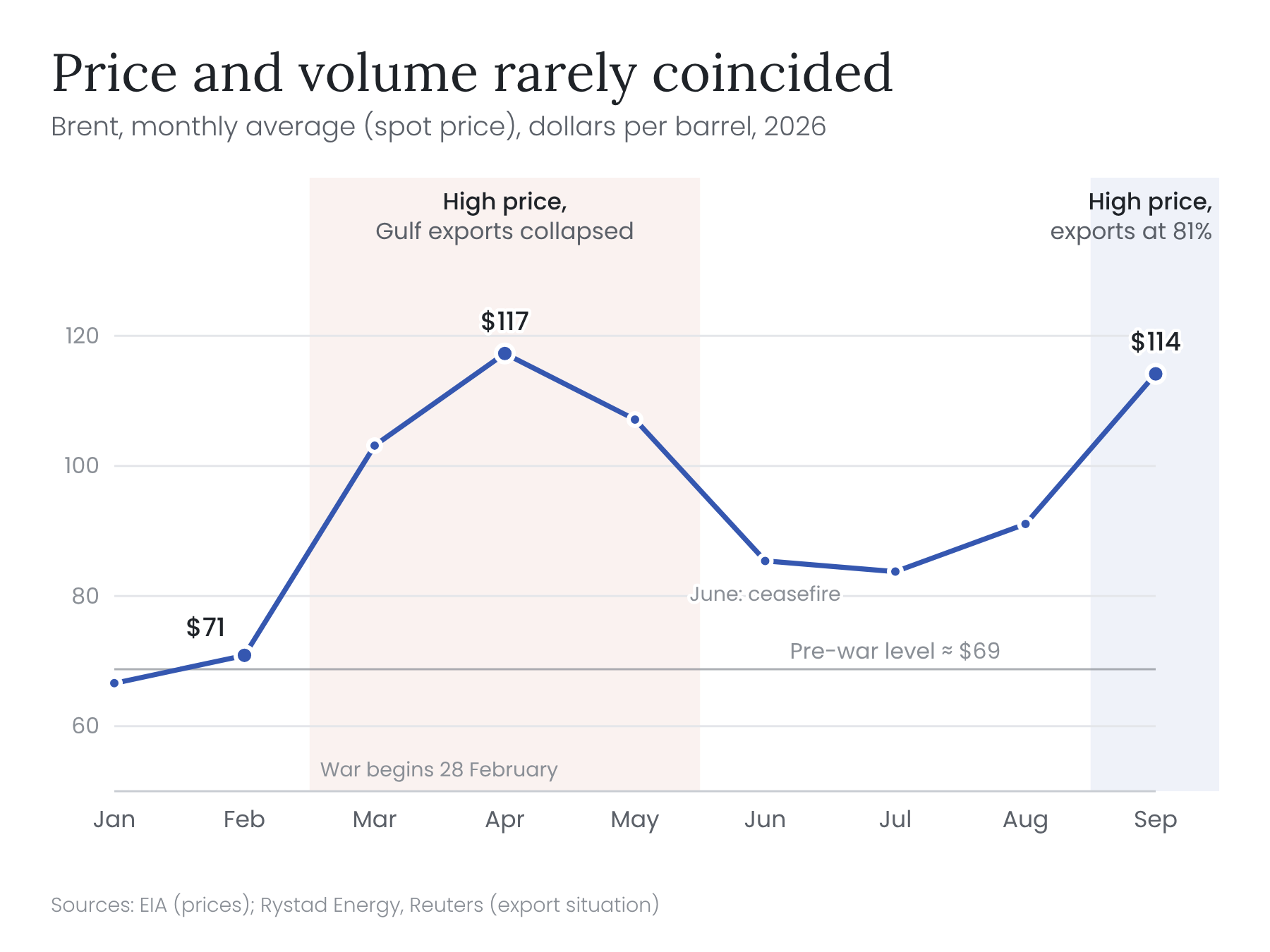
Before the war, a barrel of Brent cost around $702. In March, April and May, the monthly average was above $100 each time, and in April it reached $117. Yet in precisely these months, far less oil left the Gulf.
Output from the six major Gulf producers fell from 24.2 to 12.4 million barrels per day by the end of May3, almost by half. Iraq’s oil export revenue dropped from $6.8 billion in February to $1 billion in April.
For much of this war, high prices and high volumes did not coincide.
Only in September did both come together again: high prices and substantially recovered volumes. Brent averaged $114 for the month2. Compared with January and February, when it was around $69, this yields a gross gain of about a third despite 19% lower volume. For crude oil alone, which was back at 91% of its pre-war level1, the gain is about 50%.
That is considerable. But it is a late, partial compensation after months of severe losses, not a gain over the war as a whole.
The Gulf splits into two camps
The average conceals what matters. Whether a Gulf state won or lost depended on whether it had a route around the Strait of Hormuz – or not.
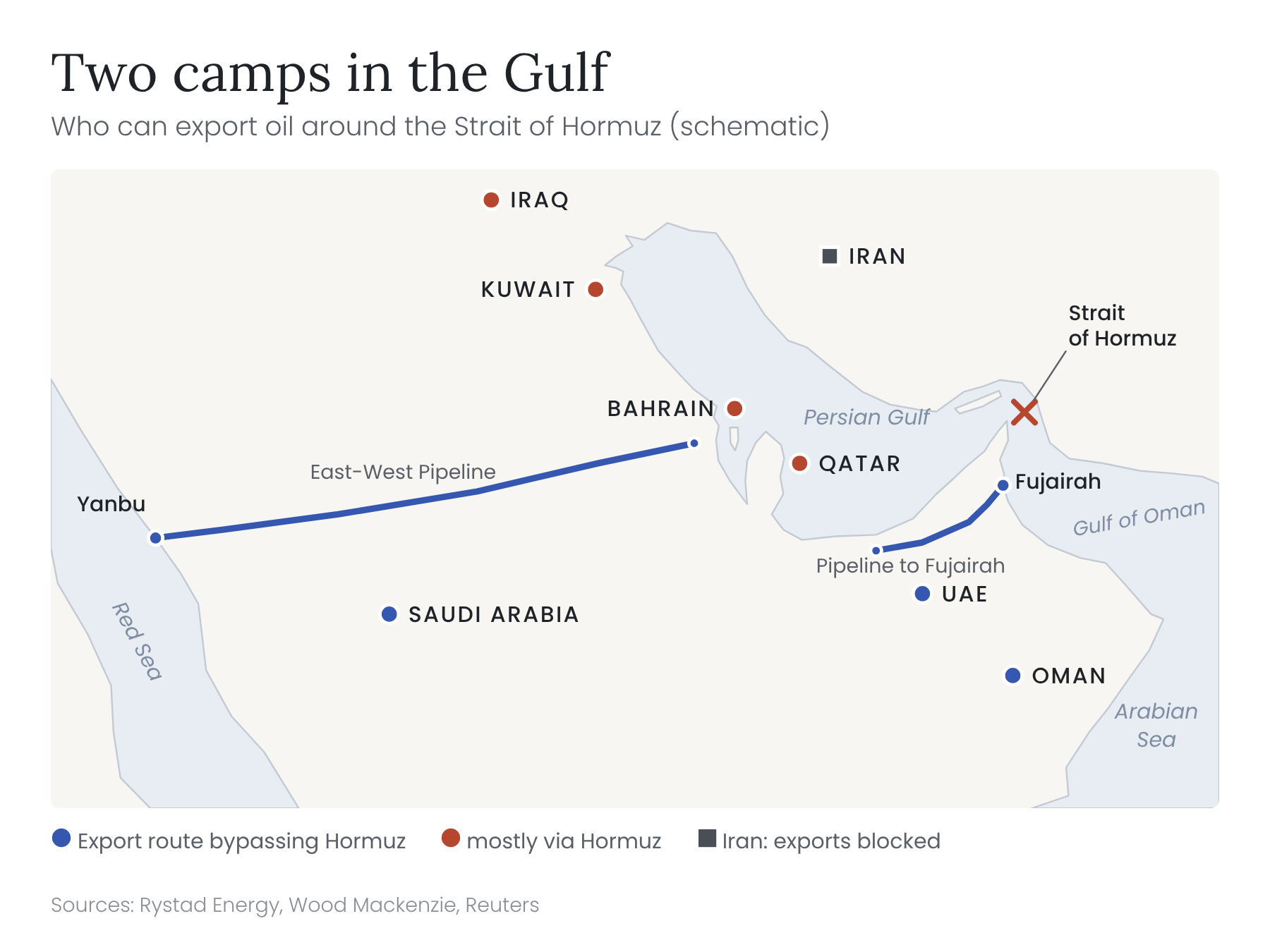
The United Arab Emirates send part of their crude through a pipeline to the port of Fujairah on the Gulf of Oman. In June, they exported more than 3.9 million barrels per day4, just short of their highest level since 2017. Oman lies outside the strait anyway.
Saudi Arabia sits in between. Using its pipeline to the Red Sea, the kingdom was able to keep delivering. In March, its oil export revenue reached around $24.6 billion3, the highest since 2022. But spending is rising faster than revenue. Riyadh now expects a budget deficit of 4.9% of GDP and an economy shrinking by 3.6%5.
On the other side are Iraq, Kuwait, Qatar and Bahrain. From April, Kuwait and Qatar at times exported no crude at all, and Iraq was at zero in June6. The International Monetary Fund expected economic output to slump by 8.6% in Qatar and by 6.8% in Iraq7.
There is no such thing as “the Gulf states” as war winners. There are countries with export routes and countries without.
The United States: oil, weapons and the cost of war
American energy companies are profiting from higher world market prices. In April, the United States became a net exporter of crude oil on a weekly basis for the first time since the Second World War8. Exports of crude and petroleum products hit a record 14.18 million barrels per day.
That does not automatically mean that “the United States” as a whole is earning money. Oil that American producers sell at higher prices at home is first of all a redistribution: what the producer gains, the consumer pays. For the economy as a whole, what counts above all is net exports. The environmental organisation Oil Change International estimates the extra revenue from crude exports alone at around $38 billion for 20269, not counting petroleum products and liquefied natural gas.
On top of that comes a second export business. From January to June, Washington announced arms sales to the Gulf states worth $41 billion, compared with $9 billion in the whole of 202510. Most of this is air defence and interceptor missiles: the Gulf states are paying for their protection against Iranian missiles and drones largely in the United States.
Against this stand the costs of the war. The Congressional Budget Office estimates the Pentagon’s costs up to 1 August at around $38 billion11, plus two to three billion a month depending on the intensity of the fighting.
On balance, the US economy as a whole is more likely to come out ahead. The winners are oil producers, exporters and arms manufacturers. Consumers and taxpayers have paid.
The silent winners
The clearest winners among the oil states are where no shots are fired.
Norway bears no war risk, needs no detours and has no war costs. It sells oil and gas at wartime prices. The government in Oslo raised its forecast for state revenue from oil and gas in 2026 from 557 to 721 billion kroner12. In March, Norway’s crude export revenue was 68% higher than a year earlier13.
Russia’s picture is more mixed. The war came at a moment of weakness for Moscow. According to an estimate by the economist Marek Dabrowski, it brought in around €13.5 billion extra between March and June14. After that, the effect fizzled out. Over the first nine months, Russia’s oil and gas revenue was even 17% below the previous year15. Not a clear winner, then, but a few months of relief at just the right time.
Who pays the oil bill
It is paid by the importing countries. The IMF names Egypt, Jordan and Lebanon, which are hit twice: through their energy imports and through the remittances of their workers in the Gulf16.
It is paid by consumers, even in exporting countries. In the United States, a gallon of diesel cost $6.20 at the beginning of October17.
And it is paid by public budgets: in Washington, in Riyadh and in the European capitals that are shielding consumers and businesses from high energy prices.
So much for the bill that can be drawn up in dollars. It is not wrong. But it has a blind spot, and I overlooked it for a long time.
The blind spot
Missing from this bill are the Iranian people. They pay with their money, with their lives and with their future.
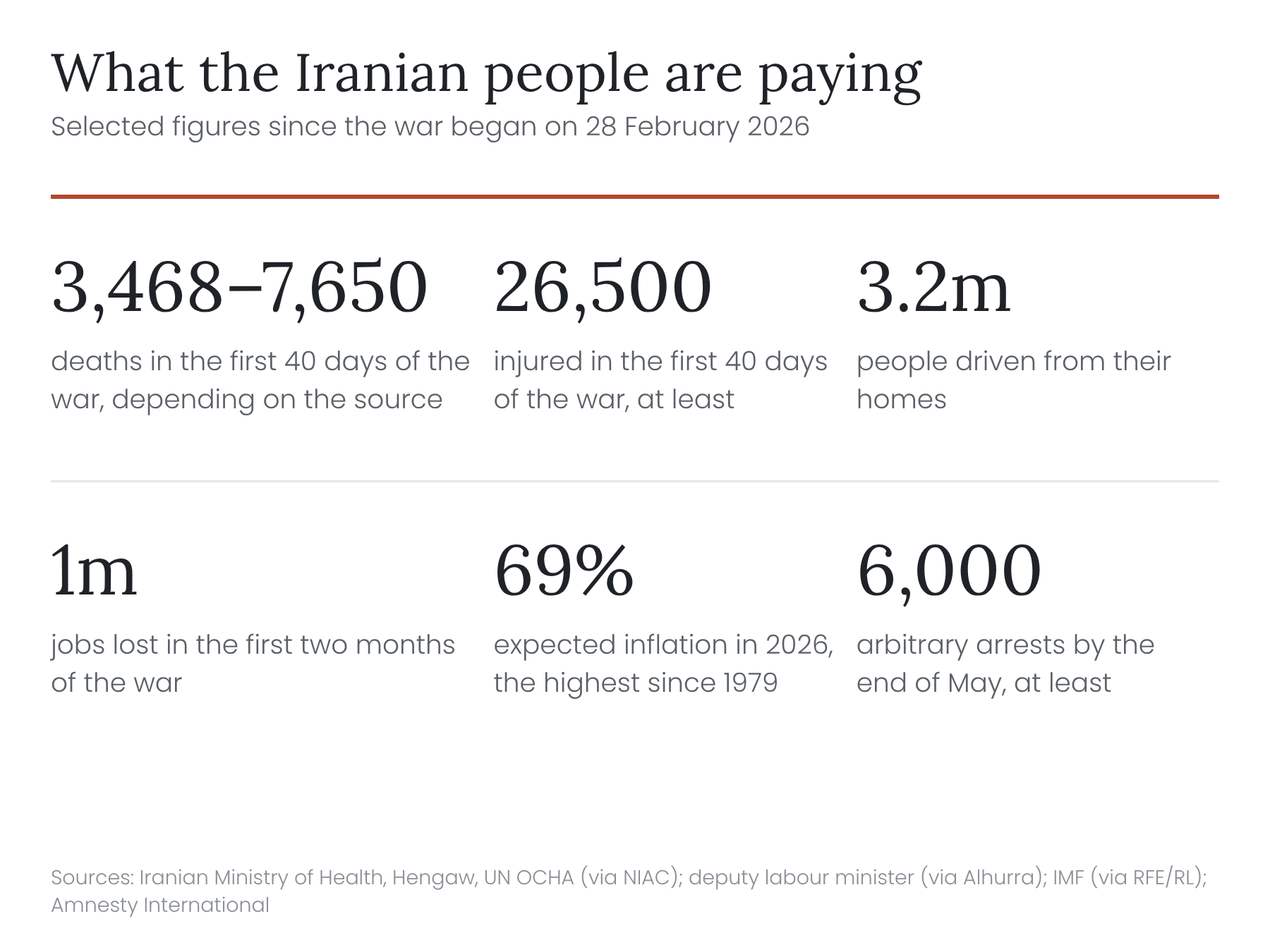
With their money: Iran’s oil exports have fallen to zero1. In the first two months of the war alone, around one million jobs were lost, according to the deputy labour minister18, and two million more workers lost hours or income. The IMF expects inflation of almost 69% in 2026, the highest since the 1979 revolution19. In Tehran, the price of bread has doubled within a year. A family of four spends around 70% of its income on basic food.
With their lives: in the first 40 days of the war alone, 3,468 people died according to the Iranian Ministry of Health, and at least 7,650 according to the human rights organisation Hengaw20. More than 26,500 were injured, 3.2 million displaced, and around 100,000 homes damaged.
With their future: the government itself puts the direct and indirect war damage at $270 billion18. The country will still be carrying this burden long after the guns have fallen silent. Inflation is already eating up people’s savings.
The bombs and missiles that claimed these victims came from the United States and Israel. That is part of the truth. But anyone who wants to know why the Iranian people keep paying this price month after month has to look at their own government.
In June, a way out was on the table. A framework agreement brought a ceasefire; the United States lifted its naval blockade and eased sanctions on the oil sector. Iran could have sold oil again. In early July, Iran attacked merchant ships in the Strait of Hormuz once more21. The United States resumed its strikes and reimposed the blockade; in mid-August, the agreement expired. Tehran accuses Washington of having broken the agreement. Its conditions for reopening the strait are now transit fees and reparations.
At home, meanwhile, the regime is waging a second war. By the end of May, according to Amnesty International, more than 6,000 people had been arbitrarily arrested and at least 39 executed for political reasons22. For 88 days, the internet was cut off for more than 90 million people, the longest nationwide shutdown ever recorded. Back in January, before the war, the regime had crushed protests that began after the collapse of the rial. An Iranian government official spoke of 5,000 dead, including 500 members of the security forces23.
A regime that treats its own people this way calculates differently from the statistics in this text. Export revenue, jobs, human lives: all of this counts for this government only insofar as it serves its power. It knows only one quantity that is not negotiable: its own survival. Any damage to the country is a price it is willing to pay, as long as others pay it.
This answers the question in the title. Oil states with secure export routes win. Importing countries, consumers and taxpayers pay a noticeable price.
But the highest price is paid by the Iranian people – with their money, with their lives and with their future. They are paying for a war in which their own government pursues only one goal: to stay in power.
How long will a people go on paying the bill for the survival of its regime?
A sanctimonious ruling elite keeps a corps of guardians aimed at its own people. That corps does not protect the faith, but the elite’s rule by force.
For this, the future of an entire generation is being destroyed. But a state of power maintained by force does not last; sooner or later it falls apart.
That is political mechanics.
Sources
- Reuters: Gulf oil flows rise to average 81% of pre-war rate in September, 6 October 2026
- EIA: Europe Brent Spot Price, monthly values
- Rystad Energy via AJOT: 1 billion barrels of lost crude supply
- Financial News: UAE Oil Exports Hit Record High, 2 July 2026
- Semafor: Saudi Arabia sees deeper budget deficits ahead, 1 October 2026
- Wood Mackenzie: Saudi Arabia’s Red Sea crude bypass
- IMF via Arab News: IMF cuts MENA growth forecast
- Reuters via Kitco: US becomes net crude exporter, 29 April 2026
- Oil Change International: Deal or no deal
- AGBI: US approves $41bn of arms sales to GCC, July 2026
- Congressional Budget Office
- Reuters: Norway raises oil, gas revenue forecast, 12 May 2026
- OilPrice: Norway’s Oil Export Earnings Surge 68%
- EU Perspectives: Iran war bought Moscow a few months
- Reuters: Russia’s oil earnings fall despite price jump, 5 October 2026
- AGBI: IMF details Iran war’s disparate impact on Mena, April 2026
- EIA: Gasoline and Diesel Fuel Update
- Alhurra: The Bill Arrives, 30 April 2026
- RFE/RL via OilPrice: Iran’s Economy Is Buckling Under the Weight of War, 14 August 2026
- NIAC: Civilian Casualties and Housing Damage in Iran
- blue News: U.S.-Iran framework agreement expires, 17 August 2026
- Amnesty International: How Iran is using war as a shield for systematic repression, 28 May 2026
- All India Radio: Iran’s death toll reaches 5,000 in nationwide protests, 19 January 2026
- Energynews: Brent Crude Tops $100, September 2026