What We Got Wrong
A Wake-Up Call to Europe’s Civil Society
15 November 2026 · Rolf Weidemann
Why this text
Europe faces the danger of a war on a European scale. This text asks how we got here. It is not looking for scapegoats but for patterns that can repeat themselves.
I belong to the generation for whom the Ostpolitik of Willy Brandt and Egon Bahr is part of their own life story. I believed in it. That is precisely why I must ask today what has become of it.
The text is addressed to the civil society of the European Union and the United Kingdom.
The core finding
We believed that whoever adopts our market mechanisms also adopts our values. Russia adopted the tools of capitalism, not its foundations – and turned them against us, while we considered our own defence superfluous.
The tools: corporations, stock-market listings, contracts, pipelines, lobbyists, seats on supervisory boards. The foundations: the rule of law, secure property, independent courts. In Russia, property has been a fief since 2003, granted in exchange for loyalty.
We welcomed this oligarchic capitalism as an enrichment. And we enriched ourselves from it: London’s property market and law firms, Europe’s energy companies, former heads of government on Russian supervisory boards.
The warning signs came early
Each of these signals was seen – and explained away.
- 1999: As prime minister, Putin unveils the restored memorial plaque to KGB chief Andropov at the Lubyanka on the founding day of the secret police. The West’s reaction: barely noticed1.
- 2000: Oligarchs in the Kremlin: whoever stays out of politics keeps his fortune. Reaction: welcomed as a return to order2.
- 2003/04: Khodorkovsky arrested, the core of Yukos auctioned off to a shell company run by Kremlin insiders. Reaction: the White House is “disappointed”; Schröder calls Putin a “flawless democrat”3.
- 2006: Murder of Alexander Litvinenko in London. Reaction: expulsion of four diplomats.
- 2007: Munich speech: a rejection of the Western order. Reaction: irritation without consequences.
- 2008: War against Georgia. Reaction: the “reset” of relations in 2009.
- 2014: Annexation of Crimea, war in the Donbas. Reaction: sanctions – and in 2015 the agreement on Nord Stream 2.
- 2019: The Tiergarten murder in Berlin. Reaction: expulsion of two diplomats.
- 2020: Poisoning of Navalny. Reaction: Nord Stream 2 remains a “private-sector project”.
- 2021: Troop build-up on the Ukrainian border, Putin’s essay on the “historical unity” of Russians and Ukrainians. Reaction: Nord Stream 2 is completed.
Oil money and the lost leverage
The oil boom from 2000 to 2008 made Putin independent. The oil price rose from under 25 to 147 dollars, and in 2006 Russia repaid almost all its Soviet-era debt. With that, the West lost its leverage – precisely in the years in which it could still have bound Putin4.
How we organised our own dependence
Dependence on Russian energy was no accident but policy – across party lines and national borders.
- London, 2000 to 2003. In March 2000, Tony Blair became the first Western head of government to meet Putin, two weeks before his first election. In June 2003, both attended the signing of the TNK-BP deal, and Britain became the largest foreign investor in Russia. Four months later, Khodorkovsky was arrested5.
- Berlin, 2005. Gerhard Schröder drove the Baltic Sea pipeline forward. Ten days before the 2005 federal election, the agreement was signed by Gazprom, E.ON and BASF in his and Putin’s presence; after leaving office, Schröder took the chair of the operating company. Shortly before the change of government, his cabinet gave an in-principle commitment to a federal guarantee for a one-billion-euro loan to Gazprom, which Gazprom later did not draw on6.
- Rehden, 2015 to 2022. In 2015, through an asset swap with Wintershall, Gazprom took over Germany’s largest gas storage facility, around one fifth of national capacity. From the summer of 2021, Gazprom barely filled it; at the beginning of May 2022, it stood at 0.6 per cent7.
- Nord Stream 2, 2015 to 2022. The second pipeline was agreed after the annexation of Crimea. In 2020, Finance Minister Olaf Scholz offered Washington up to one billion euros for LNG terminals if the United States dropped its sanctions. In December 2021 he still called it a “private-sector project”; on 22 February 2022 he halted it8.
Rehden shows the mechanism most clearly. A legal commercial deal and an owner’s freedom to fill its storage or not were turned into a weapon.
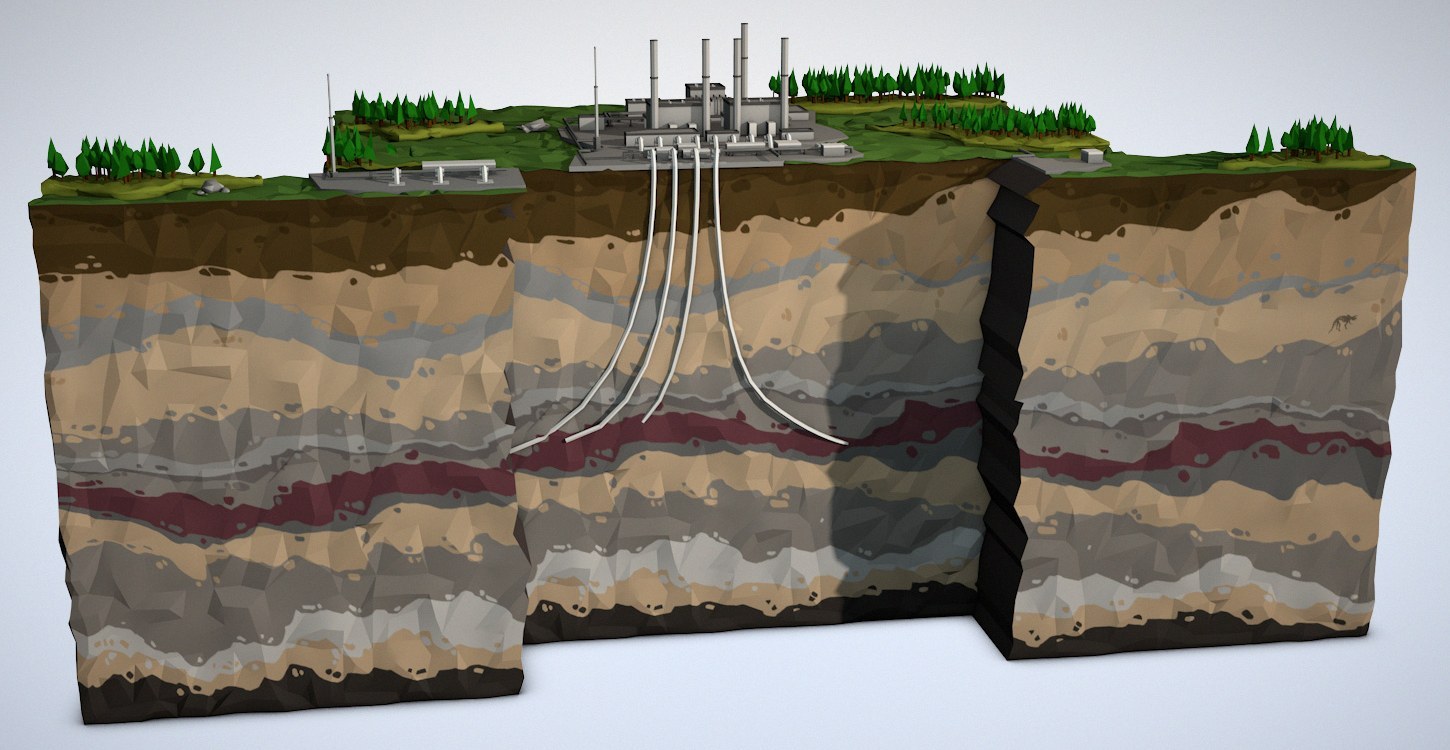
Schematic cross-section of the Rehden gas storage facility in Lower Saxony. With 3.9 billion cubic metres of working gas, it is, according to its operator, the largest gas storage facility in Western Europe. Graphic: SEFE Storage GmbH
The capture ran across all political camps: Gerhard Schröder (Nord Stream, Rosneft), the Finnish Social Democrat Paavo Lipponen (Gazprom), the Austrian FPÖ foreign minister Karin Kneissl (Rosneft), the conservative former French prime minister François Fillon. Marine Le Pen’s party financed itself with a loan from a Moscow bank9. In 2006, Angela Merkel declined any comment on Schröder’s Gazprom post and only criticised him publicly in 201710. Putin served each milieu its own narrative: business with cheap energy, the left with détente, the right with “traditional values”.
Interests and world views
Money explains why individuals let themselves be recruited, but not why governments held the same course for twenty years. Max Weber put it this way in 1920: interests govern action, but world views have, “like switchmen, determined the tracks along which action has been pushed by the dynamic of interest”. The gas business was the train, “change through trade” the switch.
Ostpolitik and its decay. Egon Bahr’s “change through rapprochement” of 1963 was a sober strategy. It was embedded in NATO and a strong Bundeswehr and led to the Helsinki Final Act of 1975, whose human-rights basket became the dissidents’ lever. In the 1980s, the SPD then sought dialogue with the regimes rather than with the societies, culminating in the joint paper with the East German SED of 1987. After 1991 the method remained, but its security half withered: the Bundeswehr shrank, conscription was suspended in 2011, and when NATO returned to deterrence after 2014, Germany agreed Nord Stream 2.
In 1973, Brandt’s last full year as chancellor, the Federal Republic spent 3.5 per cent of its GDP on defence by NATO’s calculation at the time; by 2014 it was only around 1.2 per cent. NATO’s European members together reached around 1.4 per cent in 2014; for 2026, NATO estimates around 2.6 per cent. The recent increases correct a long-standing failure; American presidents were right to demand that Europe take more responsibility for its own security11.
The blind spot of remembrance. For decades, German guilt towards the Soviet Union was directed at Moscow alone. Ukraine and Belarus, the main theatres of the war of annihilation, hardly featured in it. In the case of Gerhard Schröder, whose father was killed in the war in 1944, the reading suggests itself that this guilt became a personal mission of reconciliation – addressed to Moscow, not to Kyiv.
What the war shows
Putin sacrificed exactly the business that was supposed to bind him – for a world view: the denial of a distinct Ukrainian nation. When President Zelensky imposed sanctions on the television channels and assets of Putin’s ally Viktor Medvedchuk in February 2021, the political route to controlling Kyiv had failed. According to the Russian exile outlet Verstka, the decision to go to war was taken in March 2021; Putin counted on a quick victory and on a Europe hooked on his gas12.
The costs are enormous. The Washington-based CSIS estimates Russian losses up to June 2026 at around 1.4 million killed, wounded and missing, including up to 450,000 dead. In the first quarter of 2026, the Russian economy shrank for the first time in three years13. Putin fights on regardless. We credited him with economic rationality – but he puts his world view above it.
The six mistakes
- We mistook interdependence for taming. We believed that economic dependence would also restrain an ideological actor.
- We pursued détente without deterrence. We neglected the security half of Ostpolitik.
- We talked to regimes, hardly to societies. Oligarchs and Kremlin officials were treated as partners, dissidents as a nuisance.
- We tolerated the capture of our elites. Former heads of government moved to Russian state companies; Germany has only had a cooling-off period for members of government since 2015.
- We explained away the warning signs. Chechnya, Yukos, Georgia, Crimea and the murders in London and Berlin had no consequences for business.
- We deliberately deepened the dependence. Nord Stream 2 was agreed after Crimea and even shielded against allies.
The pattern persists
These mistakes are not in the past. Five findings show that the pattern continues to this day – and what concretely needs to be done.
1. We keep paying
- According to an analysis by the organisation Urgewald based on Kpler data, the EU spent around 7.2 billion euros on Russian liquefied natural gas in 2025, after 6.3 billion in 2024. Overall, Russian gas still covered 13 per cent of EU gas imports in 2025, worth more than 15 billion euros. The largest buyer of Russian LNG is France14.
- It comes mainly from Yamal, Novatek’s project. Novatek’s main owners are Leonid Mikhelson and Gennady Timchenko, whom Putin calls a friend. TotalEnergies came on board in 2011 in Putin’s presence and still holds 20 per cent of Yamal LNG and 19.4 per cent of Novatek; from Yamal LNG alone, it received more than 100 billion roubles in dividends between 2022 and 2024, according to research by the platform Arctida15.
- In 2014, too, Total stood by Russia. Its chief executive Christophe de Margerie openly rejected the Crimea sanctions and called Timchenko, who had been sanctioned by the United States, his friend; Timchenko was only added to the EU list in 2022. De Margerie died in an air accident in Moscow in October 2014. The first Yamal tanker bears his name16.
- The EU ban has applied to short-term supply contracts since April 2026, but to long-term contracts only from January 2027 and to pipeline gas from autumn 202714.
Demand: Do not extend the deadlines. European companies must disclose their stakes in Russian state and oligarch projects and present a binding exit plan.
2. The sanctions are full of holes
- The price cap on Russian oil is no longer 60 dollars. The EU lowered it to 44.10 dollars and froze it in July 2026, when the Iran war would have raised it automatically. Even so, the Iran war brought Moscow around 13.5 billion euros in additional revenue between March and June 2026, and the United States temporarily suspended its oil sanctions17.
- The shadow fleet carries most of the exports: in April 2026, three quarters of Russian crude went through it. The EU has listed around 690 ships and, since July 2026, has allowed seizures of inspected vessels. Estonia refrains from detentions for fear of Russian reactions, and Russian warships now escort tankers18.
- Since January 2026, fuels refined from Russian crude in third countries may no longer enter the EU. It is working: according to the KSE Institute, imports from the eleven refineries examined fell by 69 per cent by spring 2026, and those from Indian refineries by as much as 97 per cent. The Turkish Tüpraş refinery in İzmit, by contrast, has even increased its exports of such products, including to the EU19.
Demand: Keep the price cap permanently low, use seizures consistently, and put into force the already prepared full ban on maritime services for Russian oil.
3. The infrastructure is not secured
- Today Rehden belongs to the German federal government through the nationalised SEFE. Yet the storage facility is not full: at the end of October 2026, according to AGSI data, it stood at just under 20 per cent instead of the required 45. Germany’s storage as a whole was 61 per cent full, against an EU average of 75. There is no state strategic gas reserve; a draft law is still being prepared20.
- One string of Nord Stream 2 is intact. In 2025 the EU banned all transactions involving the pipelines, and Berlin and Brussels rule out putting them into operation. According to a Reuters report of October 2026, however, US special envoy Jared Kushner and Putin’s adviser Kirill Dmitriev discussed bringing an American investor into the pipelines as a building block of a peace deal. The White House denies any current talks21.
Demand: Create a strategic gas reserve under public responsibility, coordinated nationally and at European level. Review the owners of critical infrastructure. Rule out Nord Stream bindingly – even against American pressure.
4. The networks live on
- In September 2026, the EU removed the oligarchs Mikhail Fridman and Alisher Usmanov from its sanctions list under pressure from France and Luxembourg. In return, the remaining individual sanctions were extended for three years instead of the usual six months. Fridman is suing Luxembourg for 16 billion dollars. Ukraine called the decision shameful; the United Kingdom and the United States are maintaining their sanctions22.
- Roman Abramovich has been mediating between Moscow and Kyiv since 2022, helped with prisoner exchanges and in 2026 carried messages between Zelensky and Putin. At the same time, the EU General Court has upheld his sanctions three times, and the 2.5 billion pounds from the sale of Chelsea that he pledged to Ukraine have still not been paid out23.
- Since 2024, former leading politicians of Germany’s CDU and SPD have been meeting confidants of Putin in Baku, among them the chairman of Gazprom’s board, Viktor Zubkov24. On 7 October 2026, Gerhard Schröder celebrated Putin’s birthday at his home – on the same day, Russia struck Ukraine with missiles and drones25.
Whether sanctions against oligarchs are wise is disputed. They deprive the West of possible interlocutors and drive some closer to the Kremlin. But when delistings are negotiated between governments without the individuals concerned doing anything themselves, it rewards lobbying and undermines the credibility of the entire sanctions system.
Demand: Politically negotiated delistings only in return for verifiable steps by those concerned – such as releasing the Chelsea billions that Abramovich himself pledged to Ukraine. Legal protection before the courts remains unaffected. No posts in the state companies of authoritarian countries for former members of government, Europe-wide. Private back channels such as Baku must be disclosed to parliament.
5. China is Moscow’s reinsurance
- China is Russia’s largest economic partner and oil customer and the dominant supplier of dual-use goods for Russia’s weapons production – around 6 billion dollars in 2025 in the 85 most important product groups alone. The US congressional commission USCC calls China the decisive external enabler of the war26.
- When the EU sanctioned fourteen Chinese companies in July 2026, Beijing responded the next day with export bans on fourteen European companies, including Rheinmetall26.
Demand: Sanction suppliers of war materiel consistently, even in the face of retaliation. And do not repeat the Russia mistake with China: reduce dependence on Beijing for raw materials and technology now, not only in a crisis.
The lure of the way back
Uncertainty and distrust of previous governments are bringing right-wing populist parties new support in many European countries, in Germany the Alternative for Germany (AfD). These parties can advocate legitimate changes. Their Russia policy must nevertheless be measured against the interests of the people of Europe.
The AfD demands that the economic sanctions against Russia be lifted and the Nord Stream pipelines repaired. Anyone who sells a return to business as usual with Russia as the solution must be asked: Whose interests do you want to represent – Putin’s or those of the people of Europe? This course is disputed even within the AfD. That is precisely why the argument has to be fought out27.
What needs to be done now
Europe’s citizens are not asleep. According to the autumn 2025 Eurobarometer, 79 per cent of EU citizens support a common defence policy, and only 17 per cent are against it28. It was the elites who slept. This text wants to give those who are awake a language and concrete demands.
Three principles beyond the individual demands
- No détente without deterrence. The ability to defend ourselves is the second half of any Russia policy, not its opposite.
- Dialogue not only with regimes, but also with societies: support for independent Russian exile media and Russian civil society. Talks with governments on ceasefires, prisoners and arms control remain necessary – but with a mandate and parliamentary oversight, not through private channels.
- An honest culture of remembrance that recognises Ukraine and Belarus as the main victims of Germany’s war of annihilation.
Who can carry them
- the generation of Ostpolitik that has rethought it and can reach those who still believe in it
- teachers and political education
- those in the know within institutions – officers, diplomats, civil servants – who need arguments they can cite
- organisations such as LobbyControl and Transparency International, which have campaigned against revolving doors for years
- reservists, civil protection organisations, municipal utilities and operators of critical infrastructure
- the young generation, who are directly affected by the debate on military service
- our partners in the north and east of Europe, who do not need to be woken
Conclusion
Personal drives always exist: vanity, grief for a father, lust for power, wounded pride. They become dangerous where nothing restrains them.
In Russia there are no longer independent courts, a free parliament or a free press. There, the psychology of one man becomes world politics. We had these brakes – but we did not use them.
We do not need better people. We need institutions that reckon with the people we have. And we need citizens who demand that their elites build these institutions before the next mistake costs us more than gas.
Sources
- Liberties Journal: Putin’s Poisons archive
- NPR: How Putin Conquered Russia’s Oligarchy, 29 March 2022 archive
- Wikipedia: Yuganskneftegaz archive; RFE/RL, 22 December 2004 archive
- NBER: Understanding Crude Oil Prices archive; The Moscow Times: It’s time to break the bank archive
- Declassified UK via Daily Maverick archive; Dawn, 27 June 2003 archive
- WSWS: Schröder, Gazprom und die deutsche Außenpolitik (German), April 2006 archive; Financial Times via European Sources archive
- web.de (German) archive; German Federal Ministry for Economic Affairs, press release on gas storage levels (German), 14 October 2022 archive
- Reuters via Maritime Professional: Germany Offered to Build LNG Terminals to Avert US Pipeline Sanctions, 16 September 2020 archive; Willkie Compliance Concourse archive
- weekend.at (German) archive; NPR: Europe’s far right and Putin, 26 December 2014 archive
- t-online (German), 2017 archive
- UK Parliament, Hansard: Expenditure, 28 July 1980 (NATO series 1970–1979, definitions of the time) archive; NATO: Defence Investment of NATO Countries (2014–2026), 7 July 2026 archive; NATO: associated data tables, European share calculated by the author (total spending divided by total GDP of all members except the United States and Canada, in current US dollars) archive; NATO: A strong transatlantic bond in uncertain times, 18 November 2016 archive
- RFE/RL on the Verstka report archive
- CSIS: Russian Blood and Treasure archive; The Kyiv Independent on the CSIS estimate archive; cash.ch (German) archive; leinetal24 (German) archive
- High North News archive; Council of the EU: Russian gas imports – Council gives final green light to a stepwise ban, 26 January 2026 archive; Shearwater Law archive; High North News on France archive
- The Moscow Times, 27 August 2026 archive; The Moscow Times, 3 June 2026 archive; Jamestown Foundation archive; The Barents Observer archive; Arctida archive
- The Moscow Times, 22 May 2014 archive; Thane Gustafson (Substack) archive; Christian Science Monitor, 21 October 2014 archive
- Baker McKenzie archive; Bruegel archive; Foley Hoag, June 2026 archive
- The Kyiv Independent archive; Logistics Middle East archive; Atlantic Council archive
- KSE Institute: EU Ban on Products Refined from Russian Crude Effectively Closes a Major Gap in the Sanctions Regime, 11 June 2026 archive
- Wikipedia: SEFE (German) archive; Berliner Zeitung (German) archive; Analysis of AGSI data per storage site (German) archive; ms-aktuell on the gas reserve (German), 30 October 2026 archive
- The New Voice of Ukraine archive; Reuters via Cyprus Mail: US and Russia discuss American investment in Nord Stream pipelines, 8 October 2026 archive; Ukranews archive
- The Moscow Times, 22 September 2026 archive; European Pravda, 23 September 2026 archive
- The Moscow Times, 8 June 2026 archive; GB News archive
- ZDFheute (German) archive; Reuters via Internazionale: Azerbaijan president says German-Russian talks were held in Baku, 21 July 2026 archive; German Bundestag, hib 669/2026 (German) archive
- inFranken/dpa (German), October 2026 archive
- USCC: China-Russia Fact Sheet, 20 August 2026 archive; Econ4UA: China’s Support for Russia, September 2026 archive; Caixin Global, 27 July 2026 archive
- Pew Research Center: Right-Wing Populism in the Decade Since Brexit, 28 May 2026 archive; AfD: federal election programme 2025 (German), page 92 archive; ZDFheute: Laschet bei illner – Die AfD will eine schwache EU (German), 24 July 2026, section on Lucassen archive
- news.at on the autumn 2025 Eurobarometer (German) archive